
Grid Logic Fundamentals
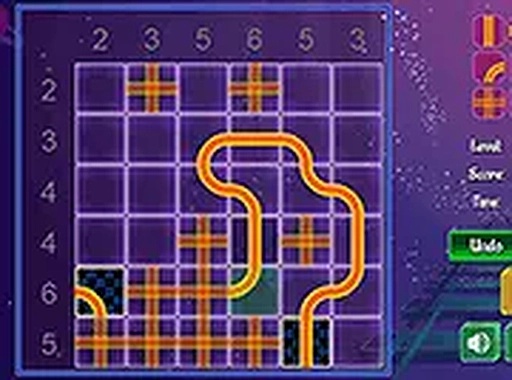
This puzzle presents a rectangular grid where the player must link a starting cell to a finishing cell by placing track segments. Numbers along the top and left edges tell how many pieces belong in each row and column. These clues are the only guide, so careful deduction is essential. The challenge lies in using these constraints to find the one correct path. Each puzzle is generated on the fly, ensuring no two games are alike. The logic is similar to nonogram or picross puzzles but with a continuous path objective.
Visual Design & Atmosphere
The interface uses a dark background with bright, glowing track pieces that stand out clearly. This neon style reduces eye strain during long play sessions and creates a focused, meditative mood. The color palette is limited to a few hues, keeping distractions minimal. The grid lines are subtle, letting the player concentrate on the numbers and the emerging path. The overall look is modern and clean, appealing to players who enjoy minimalistic design.
Progression & Difficulty Curve
New players start with small grids that have obvious clues, making the rules easy to learn. As skills improve, the grid size increases and the number hints become more subtle. The game never introduces a time limit, so each move can be considered carefully. This gradual ramp-up helps build logical reasoning without frustration. There is no scoring or leaderboard, which keeps the focus on personal satisfaction rather than competition.
Accessibility & Platform Support
Built with standard web technologies, the game runs smoothly on any modern browser. It works equally well on desktop computers, tablets, and smartphones. Touch controls are responsive for mobile users, and a full-screen option is available for larger displays. No installation or account creation is required, so players can jump into a puzzle within seconds. This makes it ideal for filling short breaks or for longer, uninterrupted sessions.







Comments
0 comments